About the project
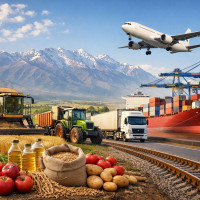
Public Procurement and Logistics Observatory (PPLO) is a platform for monitoring procurement processes and promoting best practices, initiating a dialogue between relevant stakeholders. It will perform qualitative and quantitative analysis of procurement processes in the Kyrgyz Republic, and share them with government officials and citizens through this portal, and blogs, tweets, newsletters, seminars and training. PPLO will also monitor procurement processes, distribute innovative forms of the public procurement system, and defend the best procurement methods in the Kyrgyz Republic. All this promotes cost savings and improved procurement efficiency.
The vision for institutional strengthen public procurement
The Government of the Kyrgyz Republic ensured the establishment of a public procurement system, and further is making efforts to integrate into global supply chains. Mitigating or overcoming this challenge requires a significant enhance the capacity building of the public procurement system. Existing, various short-term workshops and training courses cannot solve this problem. Therefore, it is necessary to launch educational programs at universities for bachelor, master and doctorate in public procurement.
PPLO - development and establishment of criteria for improving the efficiency of public procurement

Together with students and professionals, we set the following tasks: improving public access to information and events in relation to current public procurement of their processes. Track changes in the procurement system and practices of the Kyrgyz Republic and analysis to improve interactions between all participants in the system government procurement.

Analytics
Publications
Sarlykova Ademi
20 | 0
Why I chose logistics
Choosing a life path is always a search for one’s own rhythm in the universal symphony of the world. For me, that rhythm — the pulsing nervous system of modernity — turned out to be logistics. My decision to pursue this field may seem unexpected to some, but for me it became a conscious step toward a profession that is, in essence, the architecture of reality. It is not an escape from something, but an immersion into the very essence of how our civilization works — from a morning cup of coffee brought from distant Brazil to the complex supply chains that send satellites into space. I don’t just want to understand these connections — I want to manage them. Since childhood, I have perceived the world around me as a set of lines and flows. We live in a remarkable place, where the majestic ridges of the Tien Shan stand beside the vibrant life of cities like Bishkek. I've watched trucks from China, Russia, and Kazakhstan move along winding mountain roads like blood flowing through arteries. I’ve observed our numerous bazaars which, though seemingly chaotic, actually operate according to their own strict and well-tuned rhythms. Every vendor knows where the goods came from, where they will go tomorrow, and how to find the shortest path to the customer. This is logistics in its most ancient and intuitive form — the art of connecting points. My passion for digital graphics taught me to see structure. Any art project is not just a burst of inspiration. It is a precise plan: from sketching and choosing a palette to working with layers and creating the final render. It is the logistics of creativity: you must ensure the uninterrupted “delivery” of ideas from the mind to the canvas, optimize the “workflow route,” avoid downtime, and ultimately produce the perfect “product.” I realized that building this flawless process brings me as much joy as the final result itself. And I wanted to apply this ability — to see invisible connections and build coherent systems — to something more tangible. And what could be more tangible and important in our global world than the movement of things? Logistics is magic turned real. Ordering a book from across the ocean, having fresh tropical fruits on the table in winter, the operation of massive delivery platforms — all this is possible thanks to the colossal yet invisible work of logisticians. They are the conductors of a giant orchestra in which container ships, trucks, warehouses, and airplanes take the place of violins and cellos. And if the conductor misses a beat, the melody of modern civilization falters. As someone from Kyrgyzstan, this profession holds special meaning for me. Our country is a natural logistics hub, the heart of Central Asia. The ancient Silk Road, which connected East and West, passed exactly through this land. And today, in the era of the new Silk Road and the “One Belt, One Road” initiative, enormous opportunities lie before us. I do not want to be just a witness to this revival. I want to be one of the specialists who turn our geographic position into an economic advantage. To help goods flow through our mountain passes even faster, safer, and more efficiently, bringing prosperity to my homeland. This is not merely ambition — it is a sense of responsibility. I chose logistics because it is a profession where analytical thinking and creativity merge. It is a challenge. It is an opportunity not just to draw beautiful images, but to design beautiful, intelligent systems. Systems that save time and resources and ultimately improve people's lives. When I look at the world map covered with route lines, I don’t just see a diagram. I see a grand canvas — a painting of global exchange. And I no longer want to remain just a spectator. I want to take the brush — or a stylus, if you prefer — and begin creating. To craft not masterpieces of pixels, but masterpieces of efficiency. To transform visible chaos into perfect order. And for me, this is the highest form of creativity.
Bolotbekov Amangeldi
19 | 0
Why I Chose Logistics
Choosing a profession is one of the most important decisions in one’s life. It shapes not only our future, but also personal development, job satisfaction, and contribution to society. When I thought about my career path, I carefully considered different directions, but eventually, I consciously chose logistics. At first, I doubted whether it was the right choice. I asked myself: “Is it worth pursuing? How promising is it?” But over time, I realized that I had made the right decision. Today I can confidently say that I chose a profession that is not only interesting, but also highly in demand. Logistics is one of the most promising fields in Kyrgyzstan. The country is actively developing its transportation infrastructure: new roads, railway lines, and modernized airports. Cooperation with China has become especially important in recent years, particularly in logistics. The labor market lacks qualified specialists, so skilled professionals in this field are always needed. Moreover, logistics plays a strategic role in national development. The experience of other countries proves that an efficient logistics system can significantly improve the economy, accelerate the flow of goods, and enhance quality of life. I believe that logistics will become a key foundation for development in our country as well, and I hope to contribute to this progress. Working in logistics, I want to participate in building the future of our nation: helping establish transportation connections, optimizing processes, and teaching future generations the importance of supply chain management. I see this profession not just as a job, but as a path for self-realization and meaningful contribution. Thus, my choice is not accidental. Logistics combines potential, demand, and national importance. I am confident that this path will open many opportunities for me and allow me to be part of meaningful changes. A message for those reading this: choosing a profession is important, but not the most important thing in life. As Haruki Murakami said, “Live each day as if it were your last.” Everything will eventually fall into place — the main thing is to walk through this world with a smile. This was Aman — see you soon!
Video
01:16
Логистический потенциал: Все дороги ведут в Кыргызстан
01:13
IV Бишкекский форум по логистике: Концепция развития логистики и транспорта Кыргызской Республики до 2040 года
01:17
Выдающийся вклад в развитие логистики: награждение А.С. Уметалиева медалью «Данк»
01:55
Акылбек Жапаров принял участие в Центрально-Азиатском инвестиционном форум
01:01
Акылбек Уметалиев эфир на КТРК Изменения в госзакупках Биринчи студия
01:09
А. С. Уметалиев “Мамлекеттик сатып алуулар жөнүндөгү” мыйзам долбоорун парламентте талкуулоо
01:00
ПЕРВЫЙ ФОРУМ ПО РАЗВИТИЮ ЛОГИСТИКИ (Репортаж ЭлТР)
01:23
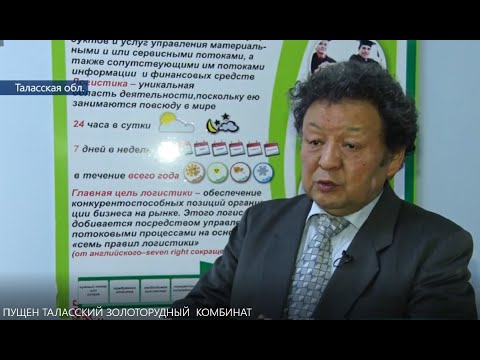
Профессор Акылбек Уметалиев об экономическом эффекте работы золоторудного комбината в КР
01:10
Комментарий Акылбека Уметалиева о запуске золоторудного комбината
01:09
Презентация открытия «Исследовательский центр логистики и государственных закупок»
Events
...
21-11-2025
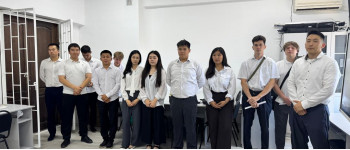
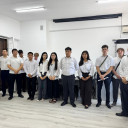
Today, November 18, students of the International Higher School of Logistics summarized the results of the essay contest “Why I Chose Logistics?” held as part of the course “Communicative Technologies in Logistics Processes” under the guidance of Associate Professor Asanalieva Elmira ...
...
19-11-2025
At the “Povod” club, one of the most anticipated and vibrant events of the academic year took place — the solemn Freshman Initiation Ceremony of the first-year students of the Kyrgyz State Technical University named after I. Razzakov. The event was held at a high artistic and organizational ...
...
13-11-2025
On November 13, 2025, the International Higher School of Logistics hosted an open lecture delivered by Marat Makaevich Usupov, Advisor to the Director of NIIEk on International Development, Ambassador Extraordinary and Plenipotentiary, and UNIDO Country Representative in the Kyrgyz Republic ...
...
12-11-2025
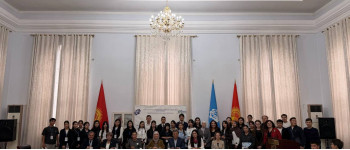
The seminar was opened by the President of TÜBA, Prof. Dr. Muzaffer Şeker, who emphasized the importance of studying the evolution of family businesses and the need for collaboration between science, government, and the private sector to ensure sustainable development. Representatives of ...
What are we going to do?
Improve
improve public access to information and events related to current public procurement and its processes
Evaluate
facilitate the flow of information between various stakeholders in public procurement
Supervise
monitor and analyze changes in the procurement system and practice in the Kyrgyz Republic
Develop
seize the opportunity to learn lessons from experience and best practices and develop recommendations for future reforms and innovations
Subscribe to our newsletter
get the latest news first!